The Orlov Trotter
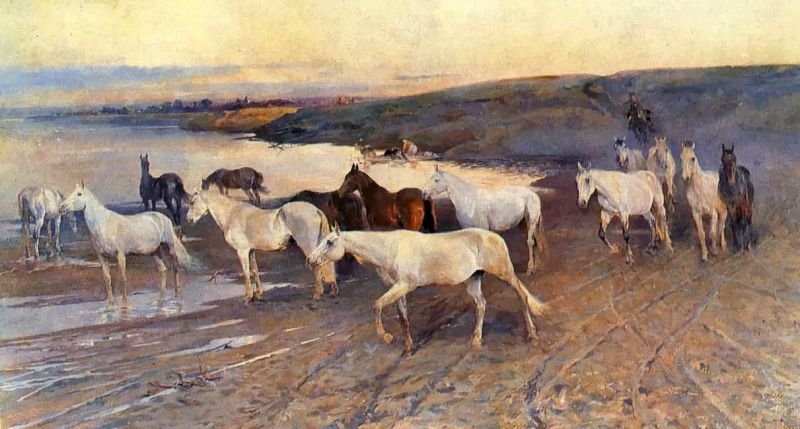
For centuries Russia and Ukraine were famous for their vast herds of small, hardy horses, raised in the steppe by either Tatars or Cossacks. As European fashions traveled east, riders sought bigger, more elegant horses, with smoother paces. Stud farms replaced open grazing, and aristocratic breeders adopted what they considered to be more scientific methods. Glory, patriotism and sporting prizes motivated these enthusiasts. Often money was no object. Count Orlov, a favorite of Catherine the Great, spent 60,000 rubles – a multi-million dollar equivalent in modern terms – to purchase an Arabian stallion, Smetanka, so called for his cream-colored coat. Before dying from overexertion or homesickness, Smetanka sired four colts and one filly with a harem of big-boned German horses, and the Orlov Trotter was off to the races.
They played an exceptional role in cavalry as well as husbandry, in drawing elegant carriages and even on the race tracks. Grand Duke Dmitry Konstantinovich, a cousin of the last emperor, owned one of the most successful Ukrainian stud farms and raised a number of race track idols, including Byvaly and Kvaleny. The Grand Duke transferred his private land to the Provisional Government in 1918, but this did not save the domain from the chaos and disorganization that the October Revolution ushered in.
The new Soviet breeders association eventually took the Orlov Trotters in hand and protected the breed. It turned out that animal breeding was a matter taken seriously by Soviet science, though one wonders how much of the success of the program came from keeping on a few of the old Grand Duke’s stable hands, versus listening to university-trained specialists. Orlov Trotters set record speeds not only in the Soviet Union, but also in races abroad, in Berlin and Helsinki.
The collapse of the Soviet Union again threatened the existence of the breed, as many breeding horses were sent to the slaughterhouse for want of buyers. Franco-Russian cooperation partly saved them, as the French began to run “Russian days” at the Vincennes Race Track to showcase the breed. Today there are 800 brood mares in Russia, and 300 brood mares in Ukraine. Since 1,000 brood mares is considered a minimum to maintain a healthy blood line, we have another reason to hope that the terrible war there will come to an end. The legacy of the cream-colored Arabian stallion lives on, for now.